Knox County sits squarely within the agricultural and suburban corridor of East Tennessee, where the invasive brown marmorated stinkbug seeks warm winter harborages between late September and mid-November. As…
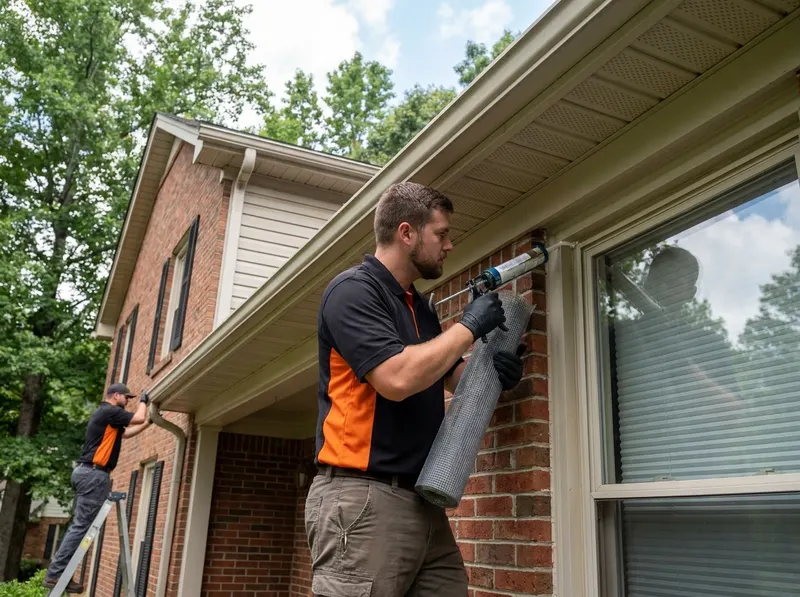
Knox County sits squarely within the agricultural and suburban corridor of East Tennessee, where the invasive brown marmorated stinkbug seeks warm winter harborages between late September and mid-November. As temperatures decline, these insects vacate deciduous tree canopies and regional orchards, migrating toward sun-warmed south- and west-facing exterior walls. Historical architecture throughout Fourth and Gill and Old North Knoxville features tongue-and-groove siding, decorative corbels, and original double-hung windows that present structural clearances exceeding the 3-millimeter threshold required for stinkbug entry. AmberTrail Extermination systematically isolates these gaps, applying weather-tested, paintable elastomeric sealants along fascia joints, mortared masonry transitions, and window perimeters to neutralize structural entry paths without reliance on interior chemical broadcasting. National Invasive Species Information Center data confirms that physical exclusionary barriers represent the single definitive containment strategy for overwintering pentatomid species, as indoor chemical applications fail to prevent ongoing structural intrusion through unsealed building envelopes.
The physiological habit of stinkbugs to emit volatile trans-2-octenal and trans-2-decenal compounds creates intense domestic distress when active clusters infiltrate finished living areas, bedrooms, or crawlspaces. In densely wooded neighborhoods like Sequoyah Hills, Rocky Hill, and Island Home Park, mature oak and hickory canopies produce concentrated pest populations that target attic louvers, ridge caps, and soffit vents. AmberTrail Extermination mechanically screens external vent openings using 20-mesh stainless-steel or brass wire cloth, which maintains attic ventilation ratings compliant with International Code Council attic airflow codes while completely barring adult insects. Mechanical exclusionary practices align with protocols set by the Environmental Protection Agency IPM Principles, mitigating the health, stain, and odor risks that arise when aggregations die inside wall voids. Technicians concurrently inspect and seal exterior conduit penetrations for HVAC refrigerant lines, outdoor spigots, and electrical panels, referencing construction guidelines from the International Association of Certified Home Inspectors to ensure moisture barriers remain intact.
Properties in Fountain City, Bearden, West Hills, and South Knoxville (SoKno) frequently present split-level or mid-century configurations where siding interfaces directly with brick veneer or stone foundations. These junctions expand during summer humidity cycles and contract as autumn cold fronts arrive, creating open thermal gaps. Rather than temporary aerosol applications that break down rapidly under ultraviolet exposure, our technicians install polyether joint sealants verified under ASTM International standards for masonry expansion, creating an environmental seal that endures regional temperature shifts. Exterior perimeter residual micro-barrier treatments may be paired with structural sealing along critical roofline elevations, adhering to application safety standards verified by the Tennessee Department of Agriculture Pesticide Division. These methods support environmental safety around domestic play areas and vegetable gardens, aligning with pollinator and beneficial insect protective measures outlined by the Xerces Society for Invertebrate Conservation.
Exclusion represents a structural defense investment: while temporary aerosol knockdown provides brief relief from visible bugs, physical sealing provides multi-season protection against the recurring cycles documented by the University of Tennessee Extension. The trade-off between exterior mechanical exclusion and recurring chemical treatments centers on labor intensity and durability; sealing involves detailed physical restoration of structural vulnerabilities, stopping indoor migration at the property envelope before pests establish winter aggregations in hidden wall insulation. Property evaluations also reference urban wildlife and pest management guidance from the Tennessee Wildlife Resources Agency and building science literature from the Oak Ridge National Laboratory Building Technologies Research and Integration Center to preserve long-term building envelope integrity. Call (865) 460-6433 to schedule an evaluation.
Every job gets a firm, written price after a free on-site visit.
Tell us about your brown marmorated stinkbug exclusion job in Knoxville and we'll send a clear, written quote, usually the same day.
 AmberTrail Extermination